Must-Haves vs Nice-to-Haves in a Project Scope
How to separate essential project requirements from extras — build a scope that protects your budget, prioritizes what matters, and avoids costly scope creep.
Articles on this site may include sponsored content. If they do, it's labeled clearly — and it still has to answer a real homeowner question. Same bar as everything else here.
Must-Haves vs Nice-to-Haves in a Project Scope
You’re planning a kitchen remodel. You’ve been saving for three years. You’ve pinned a hundred photos. You know exactly what you want.
Except you don’t. Not really.
Because when you sit down with your contractor and start translating your Pinterest board into a written scope of work, you’ll discover something uncomfortable: you can’t have everything. That $65,000 budget needs to cover the cabinets, the countertops, the flooring, the appliances, the plumbing, the electrical, the demo, the permits, and the labor. And every time you add something — a pot filler, a built-in banquette, under-cabinet lighting — something else has to give.
This is where the must-haves vs. nice-to-haves conversation starts. And it’s arguably the most important conversation you’ll have before a shovel hits the ground.
The difference between a project that comes in on budget and one that spirals is almost always the same: the first one had clear priorities from day one. The second one figured out priorities as it went — and by then, it was too late.
This guide will help you build a bulletproof priority system for your project, so you walk away with what matters most instead of a collection of compromises you didn’t fully choose.
Why most homeowners skip this step
It’s tempting to think you can figure it out as you go. After all, you’ll get bids, see the prices, and adjust from there. Right?
That approach works about as well as grocery shopping while hungry. You end up with things you don’t really need and miss the things you do.
Here’s what happens when you skip the prioritization step. You get three bids. One is $55,000, one is $62,000, and one is $48,000. The $48,000 bid fits your budget, so you go with it. Two weeks into the project, you realize the cabinets your budget bought are builder grade with particle board boxes. You wanted solid plywood with soft-close hinges. But at this point, changing means a $5,000 upgrade and a delay.
You settle. And you’re disappointed.
Prioritization fixes this. When you know what your must-haves are — the non-negotiable items that define the project’s success — you can evaluate bids honestly. If a bid is too low to include your must-haves, you know immediately. You don’t waste time hoping things will work out.
How to build your priority list
The exercise is simple, but most homeowners do it backward. They start with the budget and work up from there. Instead, start with the ideal project and work your way down.
Step 1: Brain dump everything
Take a blank sheet of paper or open a fresh document. Write down everything you want in your project. Don’t filter yourself. Don’t worry about cost. Just list it all.
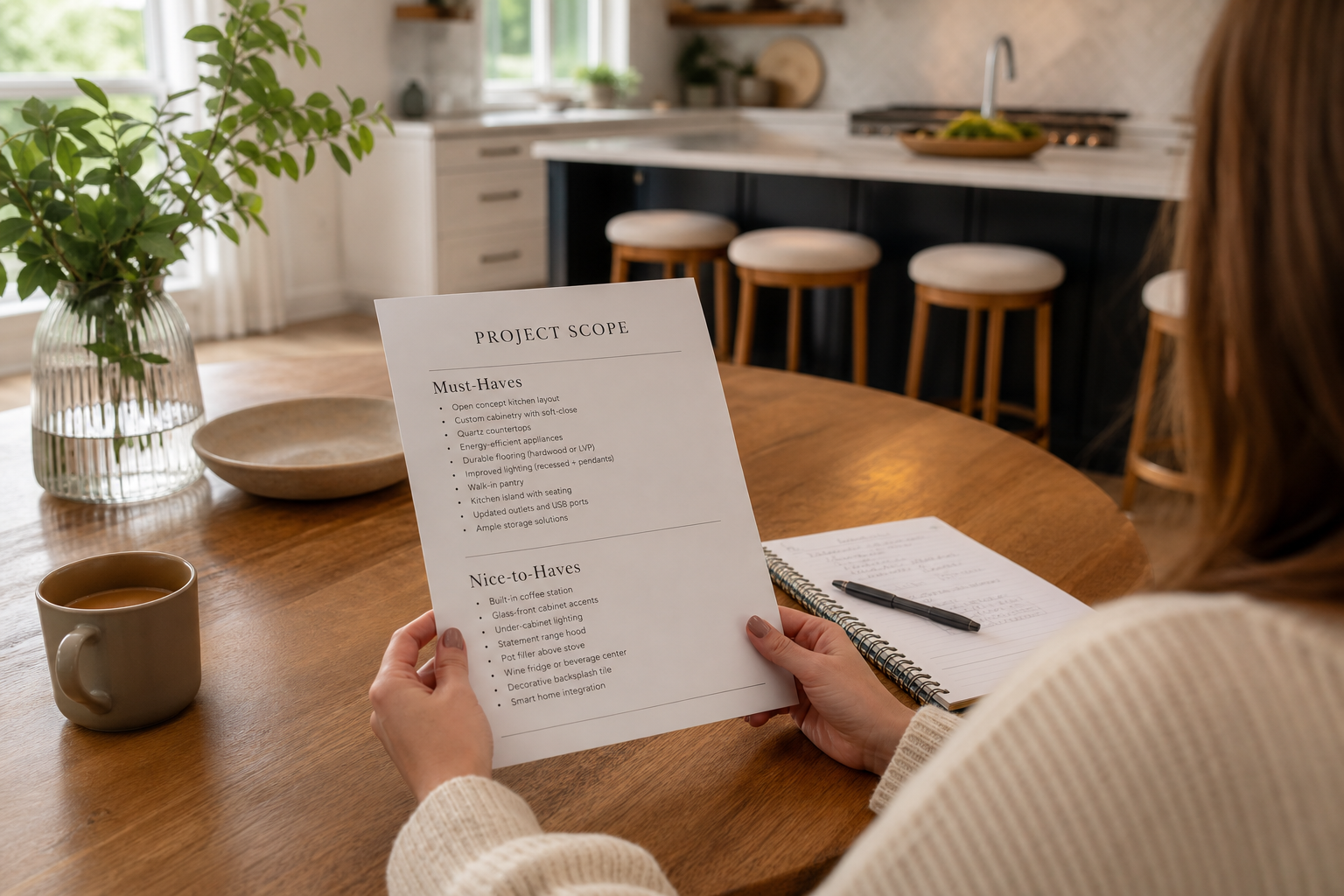
For a kitchen remodel, that list might look like:
- Custom shaker cabinets with soft-close hardware
- Quartz countertops with waterfall edge
- Professional-grade range
- Built-in refrigerator
- Marble backsplash
- Under-cabinet lighting
- Pot filler at the stove
- Large island with seating for four
- Wine fridge
- Custom pantry with pull-out shelves
- Heated tile floors
- Farmhouse sink
- Touchless faucet
- Built-in banquette with storage
- Open shelving above the sink
Get it all out. This is your dream list. It’s important to capture the full vision before you start cutting.
Step 2: Mark each item as must-have or nice-to-have
Go through every item and assign a category. Be honest with yourself.
A must-have is something that would make the project feel like a failure if it were missing. These are usually functional items that solve a real problem in your daily life. If your current kitchen has almost no counter space, adequate counter space is a must-have. If you cook every day and your current range is a 20-year-old electric coil model that doesn’t heat evenly, a good range is a must-have.
A nice-to-have is something you’d love but could live without. It enhances the project but doesn’t define it. The pot filler is a nice-to-have. The wine fridge is a nice-to-have. The heated floors are a nice-to-have — even if you really, really want them.
Be ruthless in this step. If you categorize everything as a must-have, you haven’t actually prioritized anything.
Step 3: Define what makes each must-have a must-have
This is where most people skip the important work. For each must-have, write down why it’s non-negotiable. This does two things.
First, it forces you to confirm your reasoning. If you can’t articulate why a quartz countertop is a must-have beyond “it looks nice,” maybe it’s actually a nice-to-have.
Second, it helps you evaluate alternatives later. If your must-have is “durable countertops that don’t stain,” that doesn’t necessarily mean quartz. Soapstone might work. Or solid surface. Knowing the why gives you flexibility when the budget tightens.
Step 4: Assign rough costs
Now take your must-have list and get rough pricing. Call a supplier. Visit a showroom. Browse online. You don’t need exact numbers at this stage — ballpark estimates are fine.
Add up the rough costs. If they fit in your budget, great. If they don’t, you have a decision to make: increase your budget, adjust your must-haves, or cut nice-to-haves.
This is where the real work happens. You might discover that your must-haves alone cost $70,000 and your budget is $50,000. That’s uncomfortable information, but it’s better to discover it now than after you’ve signed a contract and started cutting.
Step 5: Rank your nice-to-haves
Nice-to-haves aren’t worthless. They’re just secondary. Rank them in order of importance, from most to least. This way, if your project comes in under budget (rare but possible) or you find savings elsewhere (like doing the demolition yourself), you know which extras to add first.
A ranked list also helps with the contractor conversation. Instead of saying “I’d like to add some extras later,” you can say “If we can keep the base scope under $50,000, I’d like to add the heated floors as the first priority, then the pot filler, then the wine fridge.”
That clarity makes it easier for the contractor to help you find creative ways to incorporate more of your nice-to-haves.
How to communicate priorities to your contractor
Your contractor isn’t a mind reader. They need to know what matters to you so they can help you protect it.
Share the list early
When you’re getting bids, share your must-have list with every contractor. This does two things. First, it ensures they’re quoting on the same project. If Contractor A includes custom cabinets with soft-close hardware and Contractor B uses stock cabinets, you’re not comparing apples to apples.
Second, it tells the contractor what they can’t cut. If a bid comes in and it’s missing a must-have, that’s not a real bid for your project.
Use the list during scope reviews
When your contractor sends a draft scope of work, check every line against your must-have list. Does the scope include everything on your non-negotiable list? If something’s missing, ask why. If something’s been downgraded without discussion, push back.
Your must-have list is your compass. Every time you review a scope, a change order, or a price adjustment, check the compass.
Ask contractors where they see value engineering
Before you sign a contract, ask every contractor the same question: “If we need to cut costs, where do you see the best opportunities that don’t affect my must-haves?”
A good contractor will have ideas. Maybe they know a cabinet line that looks identical to what you picked but costs 20% less. Maybe they can suggest an alternative tile that gives you the same look for half the price. Maybe they can show you where you’re paying for a brand name when a generic product performs just as well.
The answers tell you a lot about the contractor’s experience and their willingness to help you protect your priorities.
Common must-haves vs. nice-to-haves in a remodel
Every project is different, but some patterns show up again and again. Here’s what homeowners typically discover when they go through this exercise.
kitchen remodels
Typical must-haves: Adequate counter space, functional layout, good cabinets with soft-close hardware, quality countertops that won’t stain or crack, proper task lighting, enough storage for daily use items.
Typical nice-to-haves: Professional-grade appliances, waterfall countertop edges, pot filler, wine fridge, heated floors, custom pull-out pantry organizers, under-cabinet lighting, drawer microwaves.
The pattern is clear: function beats flash. Homeowners who do this exercise almost always prioritize things that make the kitchen work better over things that make it look more impressive. And that’s the right call — a kitchen without a pot filler still works perfectly. A kitchen without enough counter space frustrates you every single day.
bathroom remodels
Typical must-haves: Proper ventilation (an adequately sized exhaust fan), waterproof surround, comfortable vanity height, adequate storage for toiletries, good lighting around the mirror.
Typical nice-to-haves: Heated floors, rainfall showerhead, body spray jets, towel warmers, smart mirrors, curbless shower entry, soaking tub.
In bathrooms, the must-haves tend to be the things that prevent problems — mold from poor ventilation, water damage from inadequate waterproofing, back pain from a vanity that’s too low. The nice-to-haves are luxury features that make the bathroom more enjoyable but don’t affect its basic function.
basement remodels
Typical must-haves: Proper moisture management (sump pump, vapor barrier, drainage), insulation, egress windows (if creating bedrooms), adequate ceiling height, proper electrical.
Typical nice-to-haves: Home theater setup, wet bar, wine cellar, exercise room, guest suite with full bath, pool table area.
Basements are where nice-to-haves run wild because the space feels like a bonus. But the must-haves matter more here than anywhere else — a basement that isn’t properly waterproofed will destroy everything you put in it.
outdoor projects
Typical must-haves: Proper drainage, adequate structural support for decks and patios, weather-resistant materials, proper permits, safety railings where required.
Typical nice-to-haves: Outdoor kitchen, fire pit, pergola, landscape lighting, built-in seating, hot tub.
Outdoor projects are interesting because the line between must-have and nice-to-have often depends on how you use the space. If you host large gatherings every summer, an outdoor kitchen might be a must-have. If you rarely use your backyard, it’s probably a nice-to-have.
How priorities change during a project
Here’s the thing about priorities: they shift. Once the walls are open and you can see the bones of your home, you might discover new must-haves you never considered.
The discovered condition priority shift
The most common priority shift happens when demo reveals a problem. Your must-have list originally said “new kitchen layout.” Now there’s a rotted subfloor. Suddenly, “proper subfloor replacement” becomes the biggest must-have of them all.
This is normal. The key is recognizing that when discovered conditions appear, they often become must-haves by necessity. You can’t ignore a rotted subfloor. But you can adjust other priorities to accommodate it.
The lifestyle priority shift
Sometimes priorities shift because you change how you think about the space. You walk through the bathroom demo and realize you actually use your bathtub way more than you thought. The soaking tub moves from nice-to-have to must-have.
That’s fine — as long as you’re honest about what moves in the opposite direction. If the soaking tub becomes a must-have, something else has to become a nice-to-have or get cut entirely. A shift in one direction requires a shift in another.
The budget priority shift
Sometimes you discover you can afford more than you thought. Maybe you got a better financing rate than you expected. Maybe you found savings in an unexpected area. When the budget expands, revisit your nice-to-have list. Move things up in priority if they still matter to you.
The risk here is the “while we’re at it” problem. Suddenly everything feels like a must-have because you have room in the budget. Stick to your ranking system. Add nice-to-haves in order of priority. Don’t let the availability of money drive your decisions.
How to build contingency into your priority system
Every project needs contingency — financial room for the unexpected. Your priority system should account for it.
The 15% rule
Budget 15% of your total project cost as contingency. This money sits outside your priority list. It’s not earmarked for must-haves or nice-to-haves. It exists to handle discovered conditions, material substitutions, and minor scope adjustments.
If you don’t use your contingency, great — you have money left over. If you use part of it, your must-haves remain funded. If you blow through it, then you start cutting nice-to-haves.
The three-tier system
A more advanced approach is the three-tier system. Divide your project into three tiers.
Tier 1: Critical. These are the things without which the project can’t be considered complete. A functional kitchen. A waterproof bathroom. A permitted electrical system. Tier 1 items are funded first. Pull money from everywhere else before touching Tier 1.
Tier 2: Important. These are things that significantly improve your enjoyment of the space but aren’t critical. Soft-close cabinet hardware. Upgraded trim. Better lighting fixtures. Tier 2 items are funded from the remaining budget after Tier 1.
Tier 3: Enhancements. These are the extras. The heated floors. The wine fridge. The custom built-ins. Tier 3 items are funded from whatever’s left — including any contingency that wasn’t needed.
This system makes it crystal clear where cuts come from. When a discovered condition eats $3,000 of your budget, you know exactly which tier absorbs the hit.
The long view
A final thought on priorities.
The must-haves in your project are the things that will still matter five years from now. The nice-to-haves are things you’ll barely remember in two years, even if you ended up with them.
When you’re making tough decisions — and there will be tough decisions — ask yourself: “Will I care about this in five years?” If the answer is no, it’s probably a nice-to-have.
A contractor once told me, “Nobody ever regrets the money they spent on good windows, a solid roof, or a well-insulated wall. But plenty of people regret the built-in espresso machine they never use.”
He was right. The features that make your home work better — that improve your daily life in measurable ways — are almost always the must-haves. The features that look impressive in photos but don’t change how you live are almost always nice-to-haves.
Build your scope around what makes your life better. Everything else is decoration.
Quick Answers
Q: How do I know if something is a must-have or a nice-to-have?
Ask yourself: “If my project were complete and I didn’t have this, would I feel disappointed every time I used the space?” If the answer is yes, it’s a must-have. If the answer is “I’d get over it,” it’s a nice-to-have.
Q: How many must-haves should I have?
There’s no magic number, but if you have more than 10 must-haves on a single-room remodel, you’re probably being too generous with the category. Focus on the items that define the project’s success — the things that would make the whole effort feel wasted if they were missing.
Q: Can a nice-to-have become a must-have during the project?
Yes. Sometimes a contractor discovers conditions that make a nice-to-have more practical to add now than later. If adding a pot filler during a kitchen remodel costs $200 (exposed wall, plumber already on site), but adding it later would cost $2,000, it might make sense to treat it as a must-have. Make these decisions deliberately, not emotionally.
Q: What if my must-haves cost more than my budget?
Then you have three options: (1) increase your budget, (2) reduce your must-haves, or (3) find cost savings elsewhere. The most common approach is a combination — you adjust some must-haves to a slightly lower quality level and find savings in less visible areas.
Q: How do I handle disagreements with my partner about priorities?
Go through the exercise separately. Each of you lists your must-haves without consulting the other. Then compare lists and discuss the differences. This prevents the more vocal person from dominating the conversation and ensures both perspectives are heard. If you still disagree, try the “five-year test” — will you still care about this five years from now?
Q: Should I share my priority list with the contractor?
Yes. The more your contractor understands what matters to you, the better they can help you make decisions that protect those priorities. A good contractor will use your priority list to guide their value engineering suggestions and flag when a budget decision might compromise a must-have.
Q: How do priorities affect the contract?
Your must-haves should be explicitly stated in the scope of work section of your contract. If a must-have isn’t in writing, it’s not part of the contract. Make sure every non-negotiable item is listed with enough detail that there’s no ambiguity about what you’re getting.
Q: What if I change my mind about a must-have after the contract is signed?
That’s a change order. Changing your mind costs money. Try to finalize your must-haves before you sign the contract. If something genuinely needs to change after signing, treat it like any other change order — document it, approve it, and understand the cost and schedule impact.
Q: Can I use my priority list to compare contractor bids?
Absolutely. The best way to compare bids is against your priority list, not against each other. Bid A might be $2,000 more than Bid B, but if Bid A includes all your must-haves and Bid B cuts corners on storage and counter space, Bid A is the better value. Your priority list is the measuring stick.
Q: What’s the most common mistake homeowners make with priorities?
Trying to have too many must-haves. When everything is a priority, nothing is. Be ruthless. Cut the list down to the things that genuinely matter. Then protect those things through every stage of the project — from bidding through scope review through change orders. Your future self will thank you.